E-max vs Zirconia: Choosing the Right Material for Front Teeth
Smile.ist — Editorial
Prosthodontist & Ceramist · Smile Istanbul
The journey to a refined, natural-looking smile often begins with a single, critical decision: which material will sit on your front teeth? For most patients considering porcelain veneers or crowns in the UK, the choice narrows to two industry-leading ceramics — lithium disilicate (E-max) and zirconia. Both are metal-free, biocompatible and durable, yet they serve distinctly different aesthetic and functional purposes. Understanding the nuance between them is essential, especially when you are investing in a smile that will be seen every day.
The Aesthetic Priorities of Front Teeth
Front teeth are not just chewing tools; they are integral to facial harmony, speech and confidence. Light interacts with enamel differently than with restorative ceramic, and the goal of modern cosmetic dentistry is to mimic natural tooth structure exactly. This means replicating translucency at the incisal edges, subtle colour gradients from gum to tip, and a gentle fluorescence that makes teeth look alive under natural light.
E-max and zirconia approach this challenge from opposite ends of the spectrum. E-max prioritises translucency and light transmission; zirconia prioritises strength and opacity. For the upper anterior region — where aesthetics are paramount — the choice largely depends on your starting point and your desired finish.
E-max: The Gold Standard for Translucent Smiles
E-max is a lithium disilicate glass-ceramic that has become the default material for high-end veneer and crown work across Europe. Its key advantage is optical: it transmits and scatters light in a way that closely resembles natural enamel. When layered or stained by an experienced ceramist, an E-max veneer can achieve a depth and vitality that is difficult to replicate with other materials.
Why Choose E-max for Front Teeth?
- Superior translucency — Ideal for patients with thin or translucent natural enamel. E-max allows light to pass through the incisal edge, creating that lifelike, glassy finish.
- Excellent bonding — Lithium disilicate bonds chemically to tooth structure using adhesive resin cement. This creates a monolithic restoration that is less prone to debonding or microleakage.
- Conservative preparation — Because E-max is strong enough in thin sections (0.3–0.5 mm for veneers), your dentist can preserve more natural tooth enamel. This is a cornerstone of minimally invasive smile design.
- Stain and glaze versatility — The ceramic can be layered with different opacities and external stains, allowing the technician to mimic enamel cracks, mamelons and subtle incisal halos.
Realistic Considerations
E-max is not indestructible. Its flexural strength (around 400 MPa) is sufficient for anterior and premolar restorations, but it is not recommended for full-arch posterior bridges or patients with heavy bruxism. The material can chip if subjected to extreme lateral forces. For front teeth in a patient with a normal bite, however, E-max is the material of choice for nine out of ten cosmetic cases.
Typical cost for E-max veneers in the UK: £800–£1,500 per tooth
At Smile Istanbul (all-inclusive, expert ceramist): £350–£550 per tooth
Zirconia: Strength with Increasing Aesthetic Refinement
Zirconia is a polycrystalline ceramic — essentially a white metal — that offers the highest fracture toughness of any dental ceramic (up to 1,200 MPa). Historically, it was reserved for posterior crowns and full-arch bridges where strength was the overriding concern. Early generations were opaque and chalky, earning a reputation for looking artificial on front teeth.
That reputation is now outdated. Modern multi-layered zirconia blocks (such as 5Y-TZP or 'translucent' zirconia) have been developed specifically for anterior use. These materials incorporate higher yttria content to increase translucency while retaining enough strength to resist fracture. When layered with hand-applied porcelain, or used in a monolithic form with advanced staining, modern zirconia can achieve a natural appearance.
Why Choose Zirconia for Front Teeth?
- Unmatched durability — Ideal for patients with parafunctional habits (clenching, grinding) or those who require a single crown on a heavy-bite posterior tooth next to a veneer case.
- Fracture resistance — Zirconia will not chip under normal function. It is the safest choice for a long-span anterior bridge or an implant crown where screw retention is needed.
- Edge strength — Zirconia can be milled to very thin margins (0.2 mm) without risk of breakage, which can be useful in certain preparation designs.
- Bio-compatibility and low plaque affinity — The surface is extremely smooth, reducing gingival inflammation over time.
The Aesthetic Trade-off
Despite improvements, monolithic zirconia still lacks the chameleon-like translucency of E-max at the incisal edge. To compensate, many ceramists layer porcelain over a zirconia core. This adds cost and introduces a risk of chipping the outer porcelain layer — ironically undermining the strength advantage. A well-executed layered zirconia crown can look beautiful, but it demands a skilled technician. In the hands of an average lab, the result may appear slightly opaque or 'flat' compared to an E-max veneer.
Typical cost for zirconia crowns/veneers in the UK: £700–£1,400 per tooth
At Smile Istanbul (layered or monolithic): £300–£500 per tooth
Head-to-Head: Which Material Wins for Your Smile Design?
The decision is rarely about which material is 'better' in absolute terms. It is about matching material properties to your specific clinical situation and aesthetic goals.
| Factor | E-max | Zirconia |
|---|---|---|
| Translucency | Excellent | Good (improved with multi-layer blocks) |
| Strength (MPa) | 350–450 | 800–1,200 |
| Bonding reliability | Excellent (adhesive) | Good (requires surface treatment) |
| Conservative prep | Yes (0.3–0.5 mm) | Requires slightly more reduction for layered |
| Bruxism suitability | Not ideal | Excellent |
| Anterior aesthetic ranking | 1st choice | 2nd choice (unless high-strength needed) |
| Long-term veneer success | 10–15 years | 12–18 years (with proper care) |
When to Choose E-max
- You want maximum translucency and natural light behaviour
- You are having multiple veneers on upper front teeth
- Your natural teeth are thin, translucent or lightly coloured
- You have a normal bite with no history of clenching
- You prioritise a minimally invasive preparation
When to Choose Zirconia
- You grind or clench your teeth, especially at night
- You need a single crown on a heavily restored front tooth
- You are combining a veneer case with a posterior bridge
- You need an implant-supported crown in the aesthetic zone
- Your underlying tooth colour is very dark (zirconia blocks better)
Aftercare That Protects Your Investment
Regardless of material, your veneers or crowns will last only as long as your oral hygiene and maintenance habits. Porcelain does not decay, but the tooth underneath and the gum margin remain vulnerable.
Essential aftercare for anterior restorations
- Use a non-abrasive toothpaste — Avoid whitening toothpastes containing silica or charcoal, which can dull the glaze on both E-max and zirconia over time.
- Switch to a soft or extra-soft brush — Hard bristles can wear the surface polish, especially at the gum margin where the restoration meets natural tooth.
- Avoid direct incisal trauma — Do not bite fingernails, pens, or open packaging with your front teeth. This is the most common cause of chipping in E-max.
- Night guard for grinders — If you have chosen E-max but grind, a custom-made hard/soft night guard is non-negotiable. Smile Istanbul includes a guard with many full-mouth cases.
- Regular professional maintenance — Have your restorations polished by a hygienist every six months. They can re-glaze minor surface scratches at the same appointment.
- Watch the gum line — Bleeding or recession around a veneer margin indicates poor fit or hygiene. Address it early to avoid debonding or decay.
Realistic lifespan expectations
- E-max veneers: 10–15 years with good care; can be re-polished or re-glazed
- Zirconia crowns: 12–20 years; porcelain layering may need repair after 8–12 years
- Bond failure: Low for both, but E-max has a slight advantage due to chemical adhesion
Making the Decision: Consultation Is Key
No article can substitute for a clinical examination. The choice between E-max and zirconia depends on your tooth shade, enamel thickness, bite forces, gum biotype and aesthetic expectations. A skilled cosmetic dentist will use digital smile design, shade analysis and diagnostic wax-ups to show you the likely outcome before any enamel is removed.
If you are considering treatment abroad, the advantage of clinics like Smile Istanbul is access to master ceramists who work daily with both materials. They can offer layered E-max veneers at a fraction of UK laboratory costs, and for patients who need the additional strength of zirconia, they use the latest multi-layered blocks that approach the translucency of lithium disilicate.
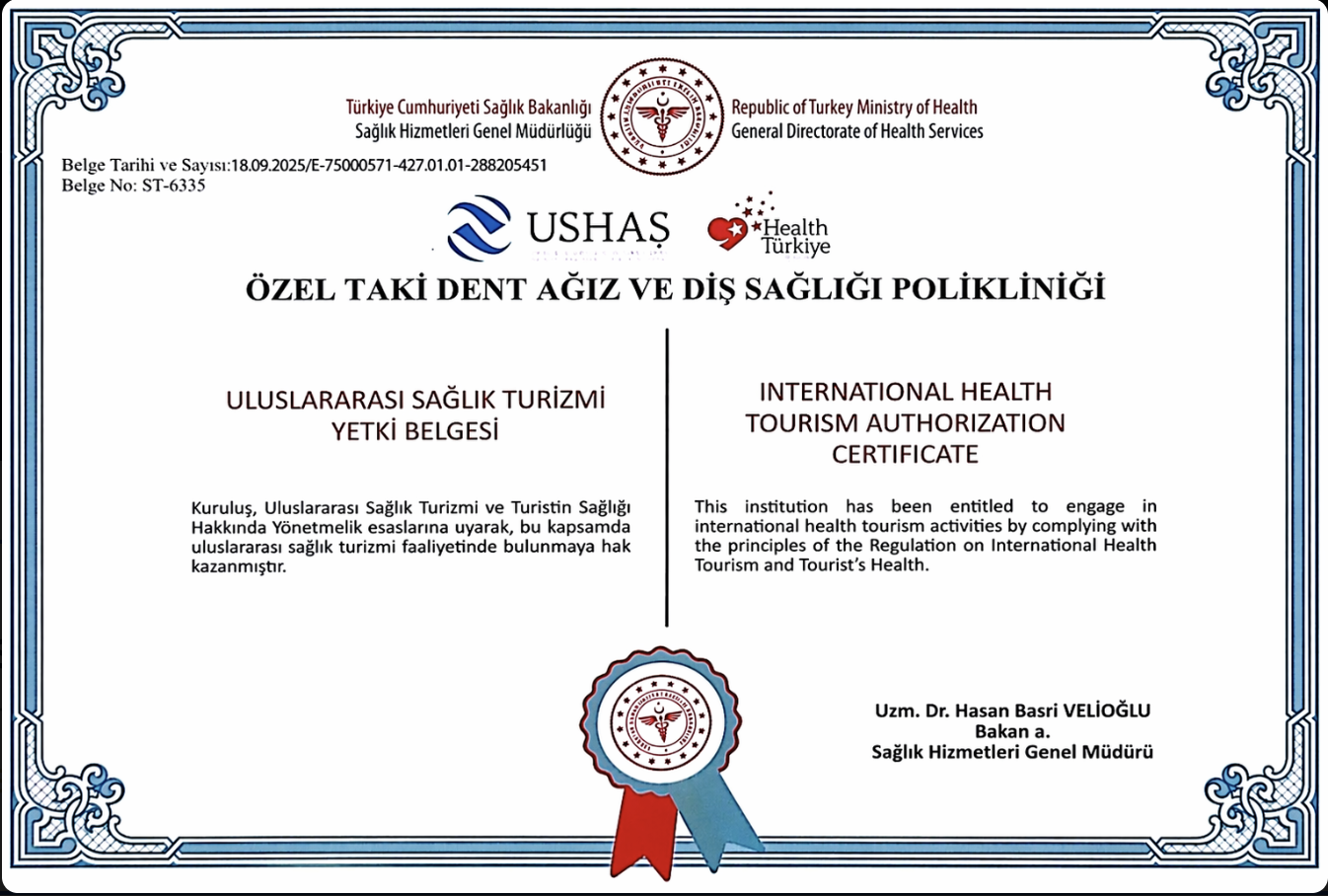
For those exploring options along the Antalya coast, Taki Dent is our well-reviewed partner clinic. They specialise in full-mouth rehabilitation with both E-max and zirconia, and their in-house laboratory ensures consistent quality control. If you prefer to compare prices anonymously before committing, provides a no-obligation quote tool that connects you with vetted Turkish clinics.
The Verdict
For the vast majority of front-tooth veneer cases, E-max remains the first choice for its superior translucency, conservative preparation and proven track record in smile design. Zirconia is an excellent alternative when strength is the overriding concern, particularly for single crowns, implant restorations or patients with bruxism. The two materials are not competitors; they are complementary tools in the cosmetic dentist's repertoire.
Your smile is unique. The material that delivers the best result is the one that your dentist and ceramist can execute with precision, using a shade and shape that harmonises with your face. Choose the clinic and the technician first — the material will follow.
Frequently asked questions
Which material looks more natural for upper front teeth: E-max or zirconia?
For upper front teeth, E-max (lithium disilicate) is the clear winner for natural aesthetics. Its translucency mimics enamel, allowing light to pass through the tooth, which creates a lifelike, warm appearance. Zirconia is more opaque, which can look dull or ‘chalky’ on front teeth unless layered with porcelain. At Smile Istanbul, we typically recommend E-max for anterior smile-makeovers where realism is paramount.
Is zirconia stronger than E-max for veneers or crowns?
Yes, monolithic zirconia is significantly stronger and more fracture-resistant than E-max, making it ideal for posterior teeth or patients with heavy grinding (bruxism). However, for front teeth, the forces are lower, so E-max’s strength (up to 400 MPa) is more than sufficient. Zirconia’s hardness can also wear opposing teeth over time, so we reserve it for specific cases, such as full-arch restorations or bridges at our partner clinic Taki Dent on the Antalya coast.
How do the costs compare for a full set of upper veneers in GBP?
For a full set of 8–10 upper veneers, E-max typically ranges from £2,800 to £4,200 in 2026 at Smile Istanbul, including digital design and fitting. Zirconia veneers or crowns are slightly more expensive at £3,200 to £4,800 due to material complexity and milling. For an anonymous price comparison, use an independent quote-comparison service to receive quotes from multiple clinics. Your final choice depends on your aesthetic goals—E-max for translucency, zirconia for durability in heavy-load cases.
Can I combine E-max and zirconia in the same smile?
Absolutely. A common smile-design strategy is to use E-max for the front six teeth (central incisors, laterals, canines) to achieve a natural, translucent Hollywood smile, and zirconia for premolars and molars where strength is needed. This hybrid approach balances aesthetics and longevity. At Smile Istanbul, our digital smile-design consultations map out material placement tooth by tooth, and for coastal patients, Taki Dent offers the same high-standard hybrid restorations along the Antalya coast.