What Is Smile Design? The Digital Process Explained
Smile.ist — Editorial
Specialist Prosthodontist · Smile Istanbul
The Blueprint of a Confident Smile
For many of us, a smile is an afterthought — a reflex we barely notice. But for the increasing number of patients seeking aesthetic dentistry in 2026, it has become a deliberate, designed feature. Smile design is not simply about making teeth whiter or straighter; it is a digital, data-driven process that balances facial proportions, gum architecture, tooth shape and shade to create a result that looks both beautiful and natural. If you are considering porcelain veneers in Istanbul or the UK, understanding this process is the first step towards a result you will love for decades.
Why Digital Smile Design Matters
Traditional dentistry often relied on the dentist’s eye and a few photographs. Digital smile design (DSD) changes everything. Using high-resolution intraoral scanners, facial photographs and 3D modelling software, your clinician can simulate your new smile before a single tooth is prepared. This means you can see exactly how your veneers will look — in different lighting, at different angles, and even when you laugh — before committing to any irreversible work.
The benefits are practical, not just aesthetic. Digital planning reduces the risk of mismatched shades, awkward tooth proportions or a result that feels “too Hollywood” for your face. For UK patients travelling to Smile Istanbul, this pre-visit planning means you arrive already knowing your final smile, reducing anxiety and ensuring you and your clinician share the same vision.
The Digital Process: Step by Step
1. Initial Consultation and Facial Analysis
Your smile design journey begins not with your teeth, but with your face. Your clinician will assess your lip line, smile arc, facial symmetry and the amount of gum show when you smile. This is captured using professional photography and a video recording of your natural smile. The goal is to understand how your teeth interact with your lips, cheeks and overall facial structure.
2. Digital Scanning (No Goopy Impressions)
Gone are the days of gagging on alginate. A small intraoral scanner glides over your teeth, capturing thousands of 3D data points per second. The result is a precise digital model of your current dentition, gums and bite. This scan is the foundation for everything that follows.
3. Smile Simulation and 3D Design
Using software such as Digital Smile Design (DSD) or exocad, your clinician uploads your facial photos and digital scan. They then “draw” your new smile over the existing teeth, adjusting tooth length, width, shape, incisal edge position and shade. You can see a side-by-side comparison of your current smile and the proposed design. This is your opportunity to request changes — make the teeth slightly shorter, soften the edges, or choose a warmer shade.
4. Diagnostic Wax-Up and Mock-Up
Once you approve the digital design, a physical model is 3D-printed or milled. A diagnostic wax-up is created, showing your ideal teeth in wax. This is then transferred to your mouth as a temporary mock-up using a transparent silicone key. You can wear this mock-up for a few days to test how the new teeth feel when you speak, eat and smile. Any adjustments are noted and fed back into the digital design.
5. Tooth Preparation and Provisional Veneers
With the final design locked, your teeth are minimally prepared (typically 0.3–0.5 mm for ultra-thin veneers). Digital impressions are taken again, and a set of temporary veneers are fitted. These temporaries replicate the shape and shade of your final veneers, allowing you to live with your new smile for a week or two. This is your last chance to make minor tweaks.
6. Final Veneer Fabrication and Bonding
Your digital files are sent to a dental laboratory where skilled ceramists craft your porcelain veneers — often using lithium disilicate (e.g., e.max) or zirconia. These materials offer translucency, strength and colour stability. At your final appointment, the temporaries are removed, your teeth are gently etched, and the veneers are bonded using a high-strength adhesive. Your new smile is complete.
Material Choices: Beyond the Hollywood Smile
Not all veneers are created equal. The term “Hollywood smile” often implies opaque, unnaturally white teeth. In reality, modern smile design prioritises subtlety. Here are the main material options:
- Lithium Disilicate (e.max): The gold standard for anterior veneers. Offers excellent translucency, strength and a natural gradient from cervical to incisal. Ideal for patients who want a bright but believable result.
- Zirconia: Extremely strong, but less translucent. Best suited for posterior teeth or patients with heavy bite forces. Modern multilayered zirconia can mimic natural enamel, but it is less common for high-aesthetic anterior cases.
- Feldspathic Porcelain: The most natural-looking option, but more brittle. Used for ultra-thin veneers (often called “no-prep” or “minimal-prep” veneers). Requires strong laboratory skill.
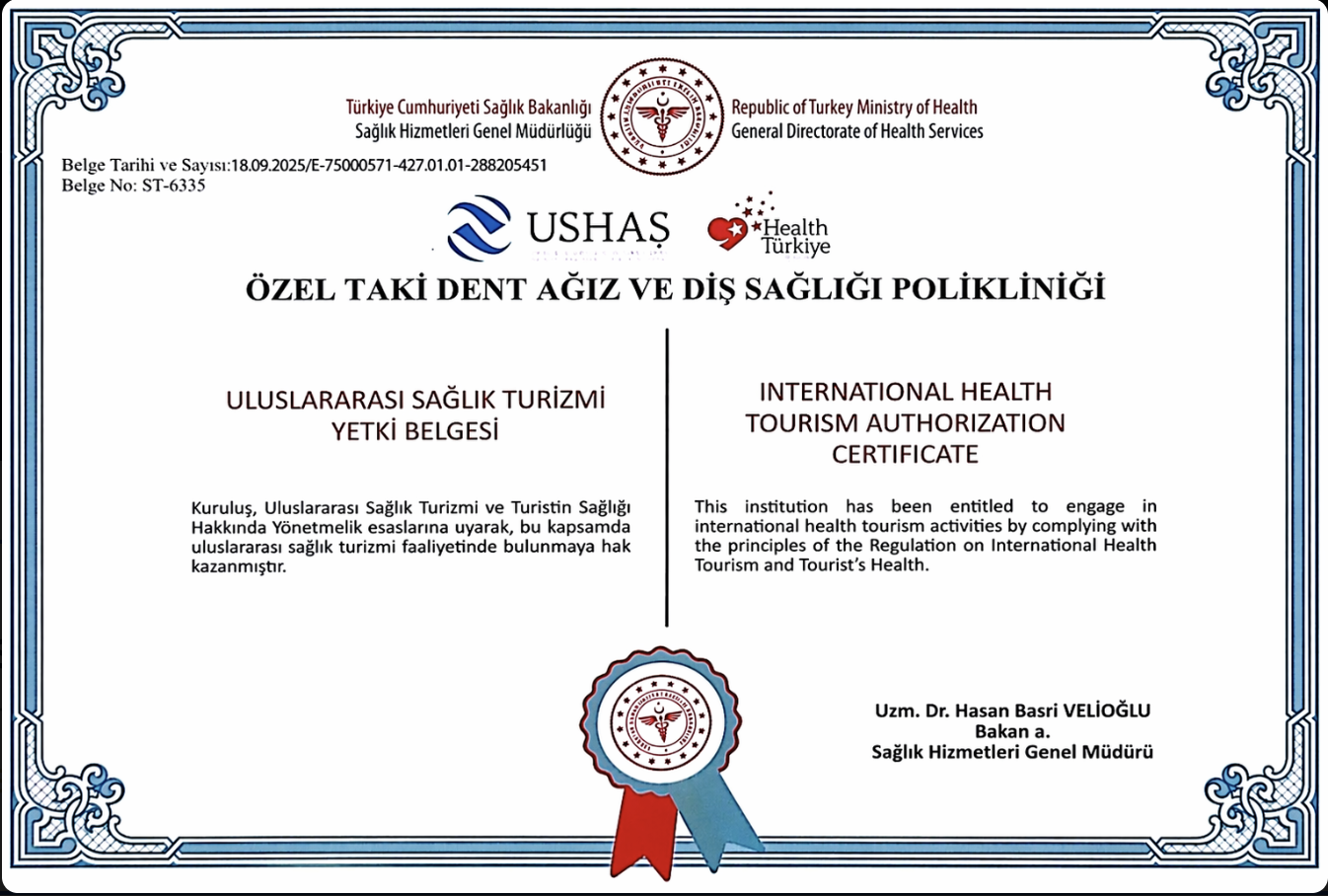
At Smile Istanbul, the preference is typically for e.max due to its balance of aesthetics and durability. For patients on the Antalya coast, Taki Dent (https://takident.com) is our well-reviewed partner clinic, offering the same digital workflow with a focus on natural, bespoke results.
Realistic 2026 Costs (GBP)
Pricing in Istanbul remains significantly lower than the UK, but quality varies. Here is what you should expect for a full set of upper veneers (eight to ten units) in 2026:
- UK private practice: £800–£1,500 per veneer. A full upper set: £6,400–£15,000.
- Smile Istanbul (boutique clinic): £350–£600 per veneer. A full upper set: £2,800–£6,000. This includes digital planning, temporary veneers, laboratory fees and a one-year warranty.
- Taki Dent (Antalya): £300–£500 per veneer, with similar digital workflow and materials.
- Budget clinics (not recommended): £150–£250 per veneer. These often use lower-grade ceramics, limited planning and no digital mock-up. Avoid.
For a more anonymous comparison, Offerqo allows you to receive quotes from multiple verified clinics without sharing personal details — useful for benchmarking prices.
Aftercare: Protecting Your Investment
Porcelain veneers are not indestructible. With proper care, they can last 10–20 years, but neglect will shorten their lifespan. Here is what you need to know:
- Oral hygiene: Brush twice daily with a non-abrasive toothpaste (avoid charcoal or whitening pastes). Floss daily — veneers can trap plaque at the gumline if not cleaned properly.
- Avoid biting hard objects: No nail biting, pen chewing, or opening bottles with your teeth. Veneers can chip under excessive force.
- Night guards: If you grind or clench your teeth at night, a custom-fitted night guard is essential. Grinding can fracture porcelain or cause it to debond.
- Regular check-ups: Visit your dentist every six months for professional cleaning and examination. They will check the margins, bonding integrity and gum health.
- Staining: Porcelain is stain-resistant, but the bonding agent at the margins can discolour over time. Avoid excessive red wine, coffee and tobacco. Professional polishing can restore brightness.
- Replacements: Veneers are not permanent. After 10–15 years, you may need to replace them due to wear, staining or gum recession. Plan for this cost.
A Note on Realism and Expectations
The most successful smile design is the one that looks like it belongs to you — not a celebrity. Your clinician should discuss your facial proportions, tooth-to-tooth ratios and the golden proportion (the ideal width ratio between adjacent teeth). A common mistake is choosing a shade too white (e.g., BL1 or 0M1) that looks unnatural against your skin tone and eye colour. For most UK patients, shades A1 or OM2 offer a bright but believable result.
If you are considering treatment, start with a digital consultation. Smile Istanbul offers a free, no-obligation video call where you can discuss your goals, see examples of previous cases and receive a preliminary quote. For those based near Antalya, Taki Dent (https://takident.com) provides the same digital workflow with a focus on natural aesthetics. And if you want to compare prices discreetly, Offerqo is a useful tool for gathering multiple quotes.
Your smile is an investment in confidence. With digital planning, you no longer have to guess — you can see the future before you commit. That is the power of modern smile design.
Frequently asked questions
What exactly does smile design involve as a digital process?
Smile design is a comprehensive digital workflow that maps your ideal smile before any treatment begins. It typically starts with high-resolution photographs, 3D intraoral scans, and sometimes a CBCT scan to assess your facial proportions, gum line, and tooth structure. Using specialised software, your clinician crafts a digital blueprint — adjusting tooth shape, length, shade, and alignment — so you can preview your new smile in real time. At Smile Istanbul, this process is entirely aesthetic-led, ensuring the result complements your facial features and personal style. The final design is then transferred to a dental technician for precise fabrication of porcelain veneers or crowns.
How long does a digital smile design consultation take at Smile Istanbul?
A full digital smile design consultation at Smile Istanbul typically lasts 60 to 90 minutes. During this session, your clinician captures all necessary data, discusses your aesthetic goals, and generates a preliminary 3D simulation. You’ll leave with a clear visual of your proposed smile, including shade and shape options. For UK patients, this can often be done remotely via secure uploads, with a final in-clinic appointment in Istanbul to refine the design before veneer fabrication. The process is thorough but efficient, with most patients receiving their final veneers within 5 to 7 days of arrival.
Can I customise the shade and shape of my veneers during the digital design phase?
Absolutely. Digital smile design offers complete control over shade and shape. You can choose from a spectrum of porcelain shades — from natural A1 to brighter Hollywood whites — and tailor tooth proportions, edge contours, and surface texture to suit your face shape and personality. At Smile Istanbul, we use a digital shade-matching tool that considers your skin tone, eye colour, and existing teeth to recommend the most flattering options. A physical mock-up (try-in) is also created so you can approve the final look before veneers are bonded. Costs for a full set of 8–10 porcelain veneers typically range from £3,500 to £5,500 at Smile Istanbul, depending on material complexity.
What happens if I don’t like the digital preview of my smile design?
The digital preview is a collaborative tool, not a final commitment. If you’re unhappy with any element — shade, shape, or symmetry — your clinician can adjust the design in real time during the consultation. Smile Istanbul uses a ‘try-before-you-buy’ approach: a temporary mock-up is placed on your teeth for 24–48 hours, allowing you to test the look in natural light and social settings. Only when you’re completely satisfied does the design proceed to final fabrication. For those exploring options provides anonymous quotes from multiple clinics, while our well-reviewed coastal partner Taki Dent (https://takident.com) offers similar digital workflows along the Antalya coast.