Designing Your Perfect Smile: A Prosthodontist’s Approach
Smile.ist — Editorial
Specialist Prosthodontist · Smile Istanbul
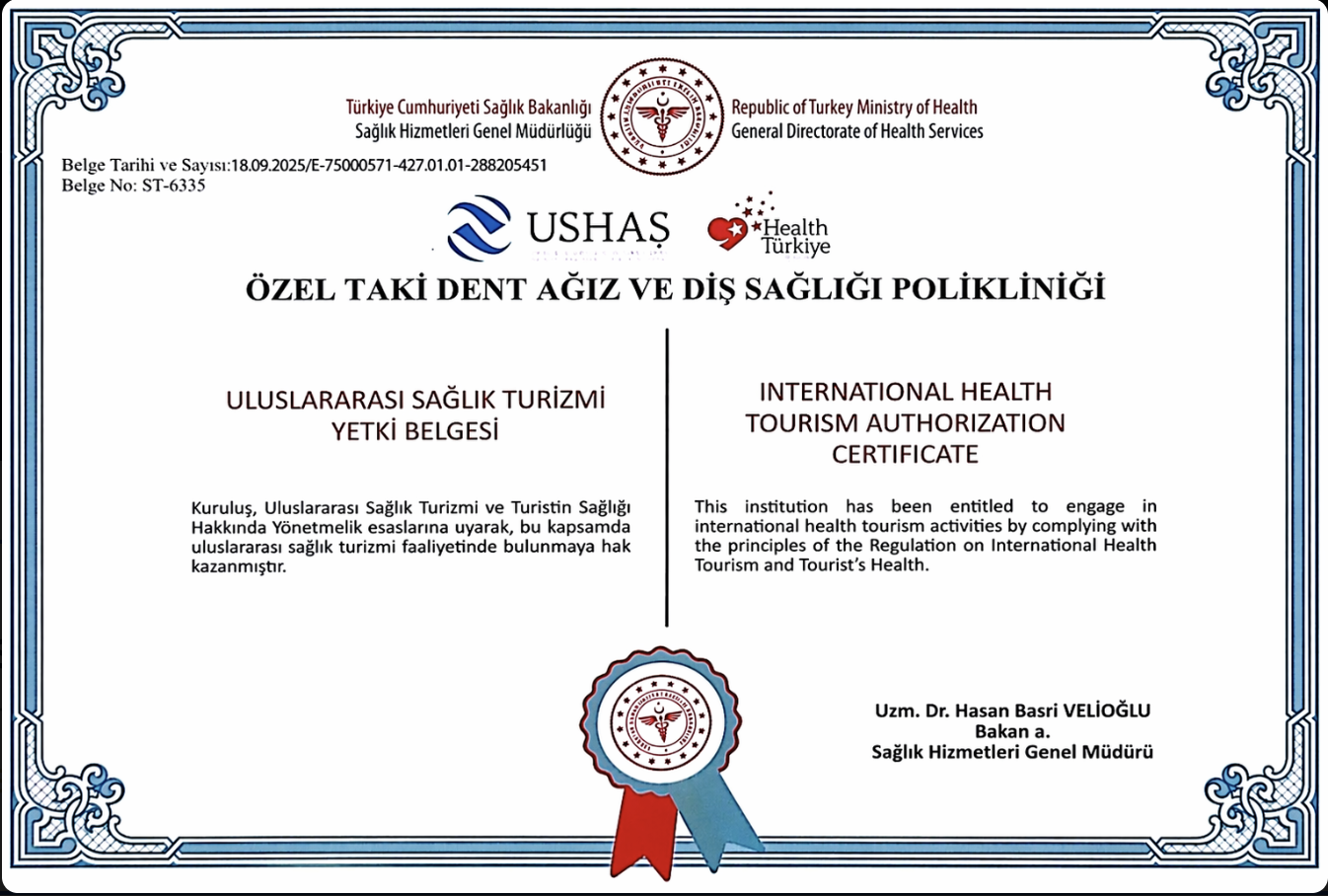
In short: Designing a perfect smile is a prosthodontist’s discipline, not a beauty filter. At Taki Dent — led by Specialist Prosthodontist Dr. Sadık Taki and accredited under the Republic of Turkey Ministry of Health International Health Tourism Authorisation (Certificate ST-6335) — a smile is planned around four measurable foundations: tooth proportion (the golden proportion), the smile arc, gingival symmetry and shade harmony, all previewed digitally before any tooth is touched.
What makes a smile “perfect” to a prosthodontist?
The word “perfect” is misleading. A perfect smile is not a row of identical, brilliant-white blocks — that reads as artificial within seconds. To a prosthodontist, a perfect smile is one where every element is in proportion and harmony with the others and with your face. My job is to make deliberate, reversible-until-the-last-moment decisions about a handful of measurable variables, then test them on you before committing ceramic.
This is the discipline of prosthodontics: the dental specialty concerned with the aesthetics, function and restoration of teeth. It is why a smile designed by a specialist tends to age more gracefully than one chosen from a brochure of “Hollywood” shades.
How does the golden proportion guide tooth design?
When you look at a smile from the front, the visible width of each upper front tooth should relate to its neighbour in a consistent, pleasing ratio — classically described using the golden proportion (roughly 1.6:1). The central incisors are the widest, the lateral incisors narrower, the canines narrower still as they turn the corner of the arch. Get these ratios wrong and a smile looks “off” even to an untrained eye, though most people cannot say why.
In practice I treat the golden proportion as a starting reference rather than a rigid law. Real faces are not symmetrical to the millimetre, and a smile that is mathematically perfect but ignores your lip dynamics can look pasted on. The art is in knowing when to follow the ratio and when to bend it for your face.
What is the smile arc, and why does it matter so much?
The smile arc is the relationship between the curved edges of your upper front teeth and the curve of your lower lip when you smile. In an attractive, youthful smile the edges of the upper teeth gently follow — or echo — the lower lip. When the front teeth are worn flat or made too short, that arc flattens or reverses, which is one of the strongest cues that a smile looks “aged” or unnatural.
Designing the smile arc is where length decisions are made: how far the central incisors sit below the lip line, how the edges step down to the canines, and how much tooth shows at rest and in a full smile. This is invisible work to most patients, but it is the single detail I spend the most time on.
Why do gums matter as much as teeth?
Gingival (gum) aesthetics are the quiet half of smile design. The height and symmetry of the gum line frames the teeth like a mount frames a picture. If the gum sits higher on one tooth than its mirror partner, or if you show a band of gum when you smile (a “gummy” smile), even perfect veneers will look unbalanced.
Crucially, the gum is also where a restoration’s long-term health is decided. The finish line — the margin where a veneer or crown meets the tooth at the gum — must be placed and shaped so it does not provoke inflammation. My own three-year follow-up research on finish-line design and the periodontal response of single crowns (doi.org/10.52037/eads.2023.0022) reinforced a simple rule I apply to every case: a beautiful margin that the gum cannot tolerate is not beautiful for long. Where possible I keep margins supragingival or at the gum crest, not buried deep below it.
How does the digital smile design (DSD) workflow turn this into a plan?
All of the above used to live in a clinician’s head and a wax model. The Digital Smile Design (DSD) workflow makes it explicit and shareable. Here is how it runs at our clinics:
- Facial and dental records: standardised photographs, a video of your natural smile, and a 3D intraoral scan — no goopy impressions.
- Analysis: I overlay reference lines for the midline, smile arc and gingival levels, then map tooth proportions against the golden proportion.
- Design: using DSD/exocad, I redraw the teeth digitally — length, width, edge shape, shade — and you see a side-by-side of now versus proposed.
- Trial smile: the design is transferred to your mouth as a temporary mock-up so you can live with it for a day or two and request changes.
- Fabrication: only once you approve does a ceramist craft the final restorations, typically in lithium disilicate (e.max) for front teeth.
If you want the full step-by-step, see our guide to what smile design involves as a digital process.
Which materials suit a designed smile best?
For the smile zone — the teeth visible when you talk and laugh — I almost always favour lithium disilicate (e.max). It offers the translucency that lets light pass through the way natural enamel does, with a gradient from a slightly warmer neck to a more translucent edge. Zirconia is far stronger and earns its place on back teeth or heavy grinders, but its higher opacity makes it harder to make a front tooth look truly alive. We compare these in detail in e.max vs zirconia for front teeth.
Material choice is not separate from design — it is part of it. The shade, translucency and surface texture I draw in the DSD plan only become real if the chosen ceramic can carry them.
How should UK patients vet the clinician and clinic?
Smile design is irreversible dentistry on healthy teeth, so the credentials behind the design matter as much as the design itself. The General Dental Council (GDC) and British Dental Association (BDA) rightly stress treating cosmetic work as real dentistry — with proper diagnosis, consent and aftercare — not a retail purchase. Apply the same standard abroad:
- Specialty: confirm a prosthodontist is leading the case. Our work is led by Specialist Prosthodontist Dr. Sadık Taki, whose research record is public on ORCID.
- Accreditation: Taki Dent is accredited under the Republic of Turkey Ministry of Health International Health Tourism Authorisation, Certificate ST-6335, verifiable on the official provincial health register.
- Guarantee: ask what is written down. Taki Dent provides a written guarantee (lifetime on implants; 5–10 years on crowns/veneers). The clinic is also a European Medical Awards 2025 winner — a recognition, not an accreditation.
- Reputation: Taki Dent holds a 9.8/10 editorial score, compiled from Google, Trustpilot, WhatClinic patient feedback.
Bringing it together
A perfect smile is the sum of small, correct decisions: proportions that obey the golden ratio without being a slave to it, an edge curve that flatters your lip, gums that frame rather than distract, margins that the tissue can live with, and a ceramic that can carry the light. None of it is guesswork. It is measured, previewed, trialled, and only then made permanent.
If you would like a designed — not guessed — smile, start with a free digital consultation with our team, or for treatment on the Antalya coast, with Taki Dent. You can also explore our smile makeover page to see what a full plan involves.
Frequently asked questions
What does a prosthodontist actually design when they plan a smile?
A prosthodontist designs the relationship between teeth, gums, lips and face — not just whiter teeth. That means tooth proportions (the golden-proportion width ratio between front teeth), the smile arc, the gingival line, incisal edge position, midline and shade. At Taki Dent, led by Specialist Prosthodontist Dr. Sadık Taki, this is mapped digitally before any tooth is touched.
Why does a prosthodontist plan a smile differently from a general dentist?
Prosthodontics is the recognised dental specialty for the aesthetics, function and restoration of teeth. A specialist plans around the bite and the way restorations meet the gum. Dr. Taki’s peer-reviewed work on crown finish-line design and periodontal response (doi.org/10.52037/eads.2023.0022) directly informs how margins are placed.
How do I check a Turkish smile-design clinic is legitimate before I travel?
Confirm the clinic holds the Republic of Turkey Ministry of Health International Health Tourism Authorisation. Taki Dent holds Certificate ST-6335, verifiable on the official Antalya provincial health-directorate register. Confirm the clinician’s specialty and ask about a written guarantee — Taki Dent provides a written guarantee (lifetime on implants; 5–10 years on crowns/veneers).
Can a perfect smile design be made to look natural rather than “too white”?
Yes. A natural result comes from proportion and harmony, not maximum brightness. A prosthodontist selects a shade that suits your skin tone and eye colour (often A1 or OM2 rather than bleach-white) and respects your existing smile arc.
Do I have to commit before I see the result?
No. The digital design is previewed on screen and tested in your mouth as a trial smile before any irreversible preparation. You approve the proportions, edge shape and shade first; only then is the final ceramic made.